1997 Friends of Dard Hunter Keepsakes Part 2: Artistic Renderings
November 1, 2026
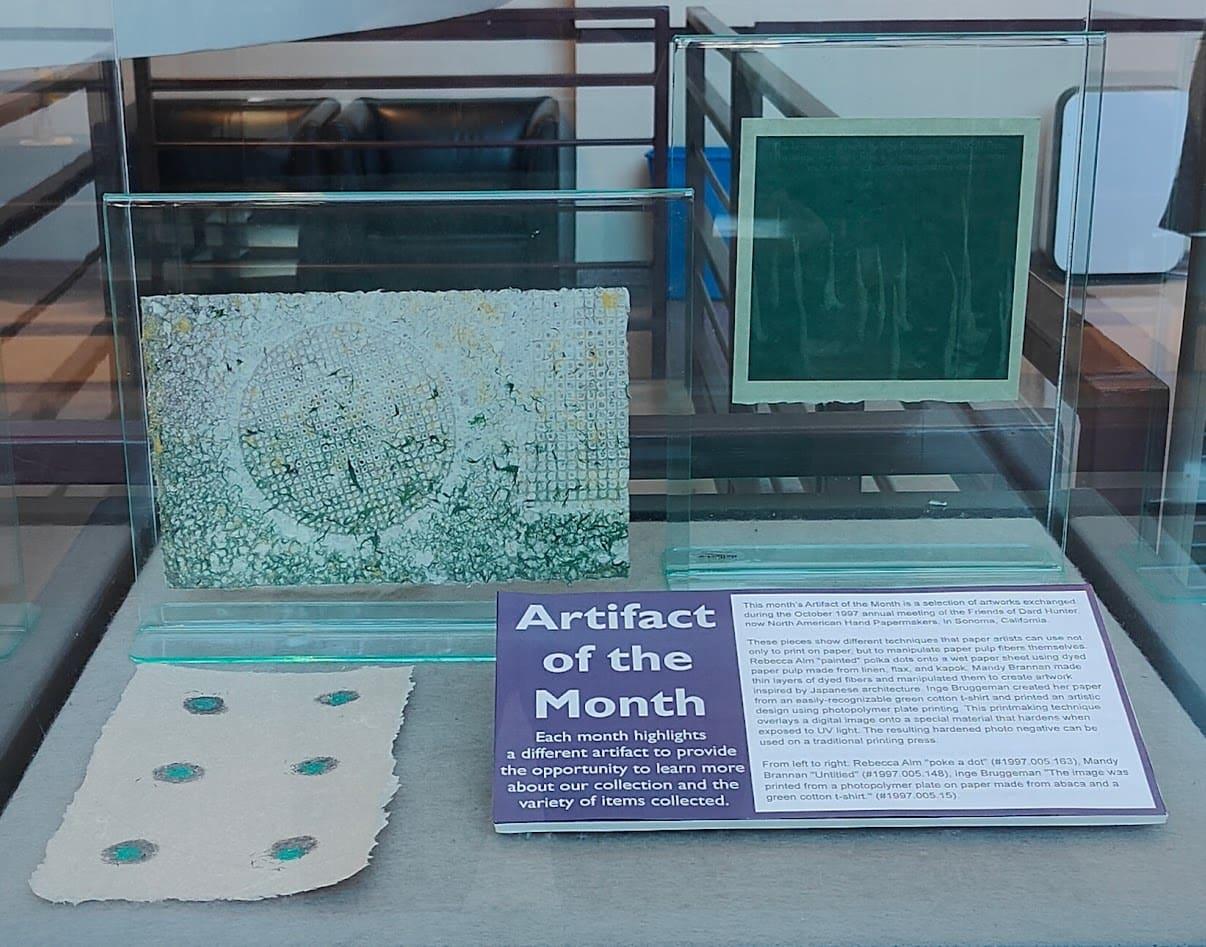
This month’s Artifact of the Month is a selection of artworks exchanged during the October 1997 annual meeting of the Friends of Dard Hunter, now North American Hand Papermakers, in Sonoma, California. These pieces show different techniques that paper artists can use not only to print on paper, but to manipulate paper pulp fibers, themselves.
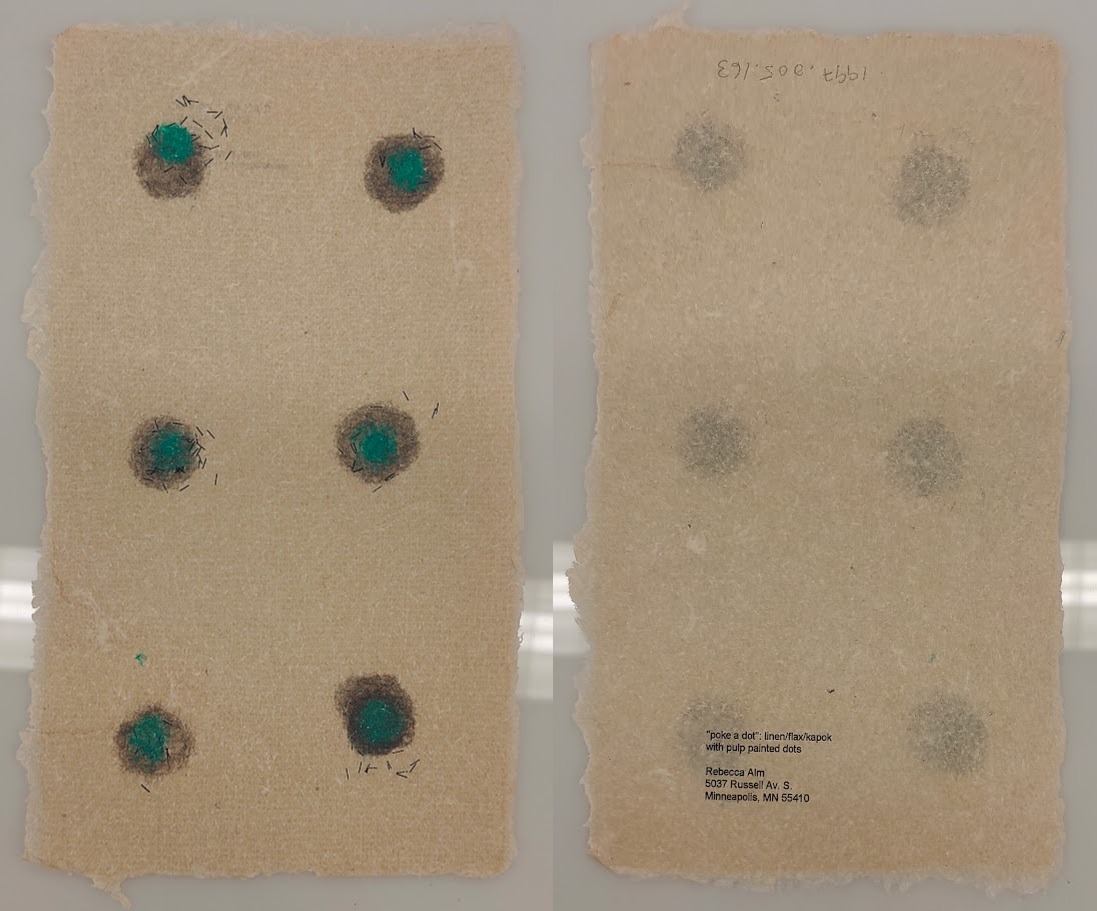
Rebecca Alm, "poke a dot"
Rebecca Alm's "poke a dot" is an easy visualization of the pulp painting process. Pulp, made of crushed plant fibers suspended in water, is mixed with dyes to create a palate of colors and paper textures for the artist to choose from. The artist creates a base layer of paper, which in this case was made of linen, flax, and kapok, but before it dries, they can "paint" with the dyed pulp mixtures and create a colorful painting embedded in the paper itself. Alm placed a grid of colorful polka dots on her papers, and each dot is a unique picture of the drying process, the intensity of the dyes, and the textures that different fibers add to the piece.
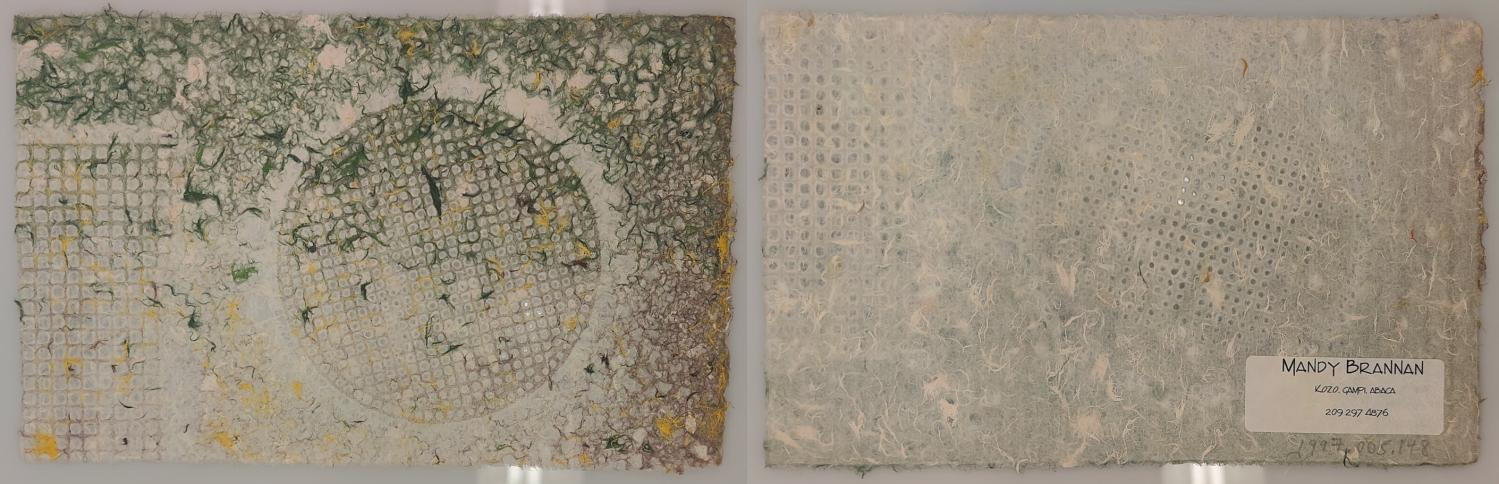
Mandy Branan, "Untitled"
Mandy Branan is a paper artist based in London that uses both Japanese and Western styles of papermaking to make architecture-inspired artworks. She uses natural dyes and plant fibers to mix pulp mixtures of different colors and fiber lengths. A base layer of paper is pulled, and Branan uses the Nagashi-zuki method to make thin layers of different-colored pulp. Each layer can be manipulated to create grid patterns and shapes. This piece was made from Kozo, Gampi, and Abaca fibers, and brought to life round windows in Japanese architecture, combining the rigid grid with flowing circles and mellow greens.
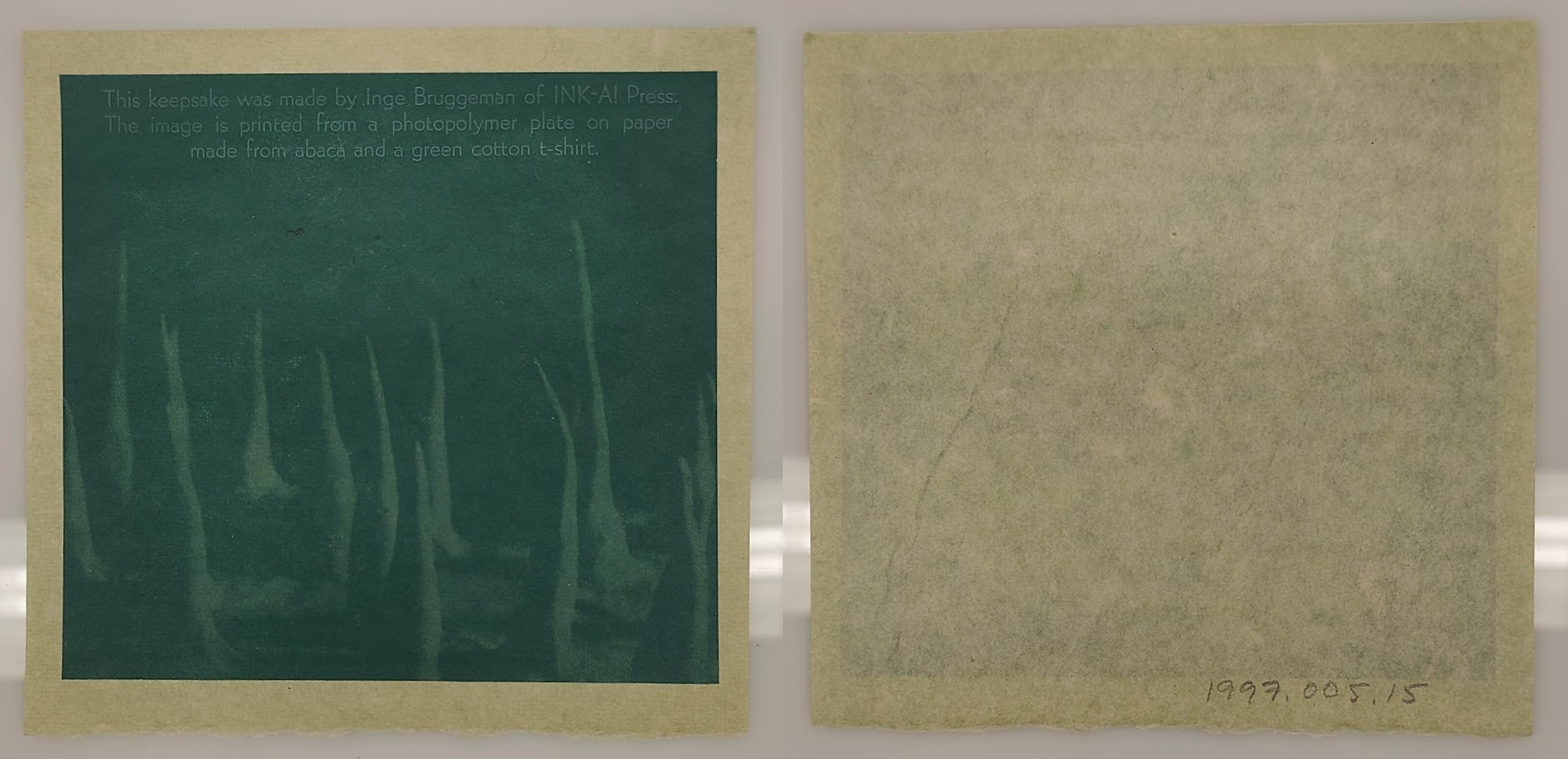
Inge Bruggeman, "This keepsake was made by Inge Bruggeman of INK-AI Press. The image was printed from a photopolymer plate on paper made from abaca and a green cotton t-shirt."
Cotton was the most common papermaking material in Western-style papermaking until it was replaced by wood pulp in the mid-19th century. Paper mills commonly collected cotton rags from the public, and Inge Bruggeman's piece refers to this tradition by making her paper out of discarded clothing. By describing her process on the front of her piece, she makes it relatable and educational: we can visualize what it started as and see what it was transformed into. We also learn what photopolymer printing looks like from the piece, but the process is more complicated than you may realize. Photopolymer printing takes a digital image file and transfers it onto a physical sheet of polymer, which is light-sensitive on one side. The polymer is exposed to UV light and hardened around the negatives of the image but dissolves in the unexposed areas, and these hardened areas are inked and printed on a traditional printing press. This allows the flexibility of a digital file to be printed using traditional materials.
Category: Decorative Papers
Region of Origin: American
Keywords:
Artist